
The tool
From activity data to a reportable number
CS3 compares a business-as-usual baseline against a circular scenario across the Scope 3 categories. Furthermore, it now puts the economic cost of each strategy right next to its carbon result. The screens below are from the live tool, running on a fictional mid-size injection moulder company, built to be dimensionally realistic for the sector. Every figure is computed by the tool.
Measure the delta
 Add
Add figures/tool-results.jpgthe results overview screen
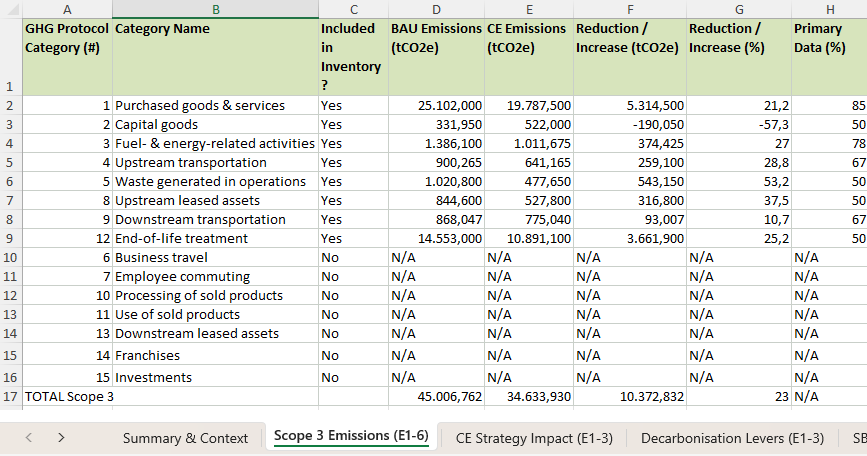
See how every category performs
 Add
Add figures/tool-categories.jpgthe per-category breakdown screen
Rank the circular strategies
 Add
Add figures/tool-prioritisation.jpgthe strategy-prioritisation screen
Does it pay back?
 Add
Add figures/tool-economics.jpgthe economics screen (new)
Does it get you to target?
 Add
Add figures/tool-sbti.jpgthe SBTi progress screen
Is it disclosure-ready?
 Add
Add figures/tool-esrs-export.pngthe ESRS E1 export screen
See it run on your own numbers
Book twenty minutes and I will walk you through CS3 on a live assessment for free: which strategies have the strongest carbon performance, which of them pay back, and what a disclosure-ready export actually looks like.
If you would like to see it on your own data, send me one product line, packaging portfolio or site before the call and I will have it modelled by the time we speak.
Anything you send stays between us. Anonymised data works just as well.